Interconnected Decision Trees in Blackjack: Card Values Directing Hits, Stands, and Insured Split Payouts
Cameron Lange · Aug 21, 2026
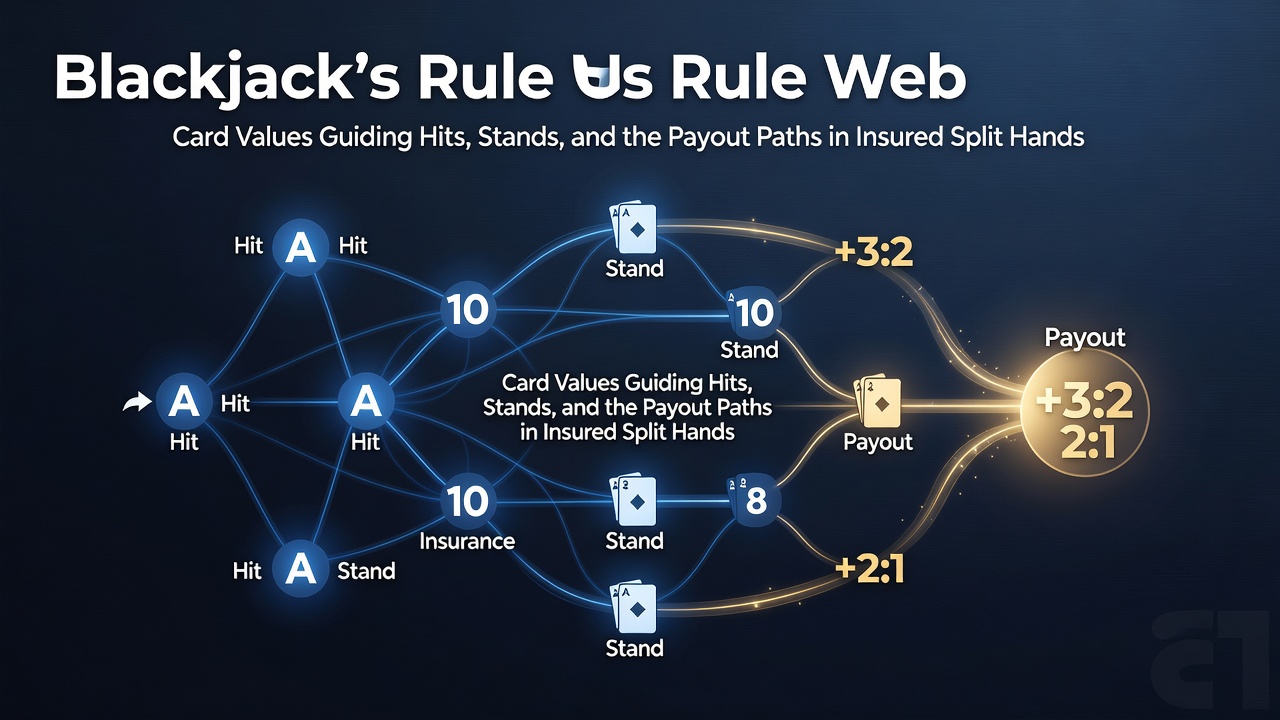
Interconnected Decision Trees in Blackjack: Card Values Directing Hits, Stands, and Insured Split Payouts
Blackjack rules form a tightly linked system where each card value determines the next action and shapes the final payout when insurance and splits operate together, according to standard gaming commission guidelines from multiple jurisdictions. Card values range from numbered cards at face value through face cards at ten and aces that count as one or eleven, and these numbers set the thresholds for hitting or standing while insurance bets protect against dealer blackjack in split scenarios.
Players evaluate their initial two cards against the dealer upcard, and the arithmetic quickly branches into multiple paths because a split creates two separate hands that each require independent decisions. When insurance is active the dealer has checked for blackjack, which locks in the insurance payout structure before further hits or stands occur on the split hands.
Card Values as the Foundation for Hit and Stand Thresholds
Standard rules assign numeric values that remain constant across most casino formats, yet the same values trigger different choices once splits and insurance enter the sequence. A hard total of sixteen against a dealer ten requires a hit in many rule sets, while the same sixteen after a split may shift because the insurance bet already resolved the dealer blackjack possibility and altered the remaining payout math.
Researchers tracking decision pathways note that ace values introduce the greatest flexibility because they switch between one and eleven without changing the physical card on the table. This switch affects whether a hand qualifies as soft or hard, which in turn dictates whether additional cards can be drawn before the total exceeds twenty-one and voids the hand.
Split Mechanics and Insurance Interaction
Pair splitting doubles the number of active hands and therefore multiplies the number of payout calculations that depend on subsequent card values. Insurance, offered when the dealer shows an ace, pays two to one if the dealer holds blackjack and removes the main bet risk before any split hands receive further cards.
Once insurance resolves, each split hand follows its own card-value path while the overall payout structure accounts for any insurance win or loss. Data from regulatory reports in Nevada and New Jersey show that players who split pairs of eights against a dealer ace frequently purchase insurance first, then apply hit or stand rules to each new hand based on the fresh totals.
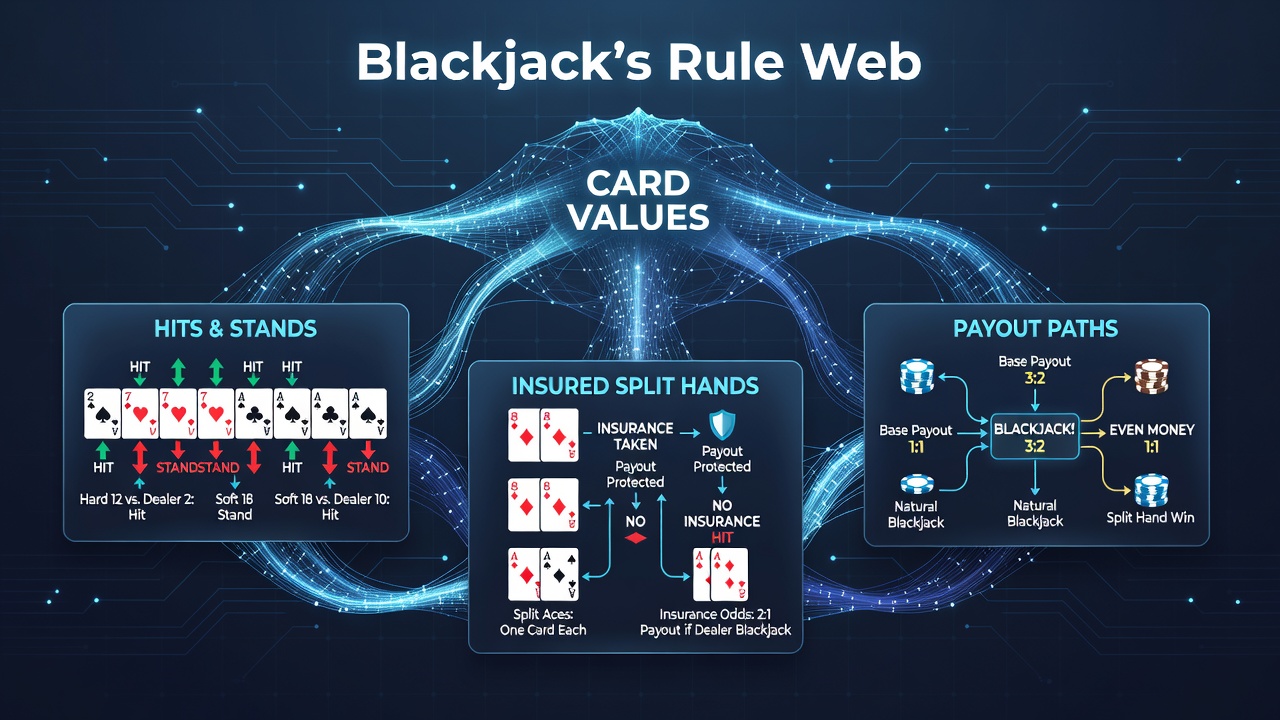
Payout Pathways Under Combined Rules
Payouts in insured split situations follow a sequence where insurance settles first, then each split hand resolves according to its final total. A hand that reaches exactly twenty-one after a split pays three to two unless the dealer also holds twenty-one, in which case the bets push. When insurance was taken the net result combines the insurance outcome with the main bet result.
Observers tracking multi-split outcomes report that erroneous hit decisions on one split hand can cascade into lower overall returns because the second hand may then face a stronger dealer position. Studies from the University of Nevada, Reno gaming research program indicate that precise card-value tracking reduces these cascading effects by keeping each hand on its optimal path.
Decision Branching in Real Play
Take one scenario where a player holds a pair of nines against a dealer six and buys insurance. After the insurance bet resolves without a dealer blackjack, the player splits and receives a three on the first nine for a twelve and a seven on the second nine for a sixteen. The twelve receives a hit while the sixteen stands, illustrating how initial card values steer separate branches even though insurance already locked part of the payout structure.
Another common sequence begins with a pair of sevens against a dealer ace. Insurance is purchased, the dealer reveals no blackjack, and each seven receives an additional card that changes the totals. The resulting hands then apply standard hit or stand rules independently, yet the insurance payout remains fixed from the earlier check.
Regulatory Context and Rule Consistency
Gaming authorities in multiple regions maintain consistent card-value definitions even as other rules such as surrender or doubling restrictions vary. The Australian Commission for Gambling and Racing and the New Jersey Division of Gaming Enforcement both publish rule summaries that emphasize the same numeric assignments for cards while detailing how insurance and splits interact with those values.
Industry reports compiled by the American Gaming Association further document that payout pathways remain predictable when players follow card-value thresholds, regardless of whether insurance is active. These consistent frameworks allow software and training programs to map every possible decision tree in advance.
Conclusion
Card values serve as the unchanging reference points that guide hit and stand choices while insurance and splits create parallel payout calculations. The sequence begins with the initial deal, moves through insurance resolution when offered, then branches across split hands according to the same numeric rules that govern single-hand play. Regulatory sources across jurisdictions confirm that this interconnected structure produces measurable payout outcomes once the card values are applied consistently at each step.